Eating out doesn't have to derail your diet.
You're at a restaurant, the menu looks amazing, and there's no calorie count anywhere. How do you stay on track without being the annoying person who asks "how many calories in this?"
The Problem with Restaurant Calories
Unlike packaged foods with nutrition labels, restaurant meals are a black box:
- No calorie info: Only chain restaurants (over 20 locations) are required to show calories in the US
- Hidden ingredients: Butter, oil, and cream are added liberally but invisible on the plate
- Portion distortion: Restaurant portions are 2-4x what you'd serve at home
- Menu psychology: "Healthy" options like salads can have more calories than burgers due to dressing
Research shows that people underestimate restaurant calories by 40-60%. That "healthy" salad you ordered? It might be 800 calories.
5 Strategies to Estimate Restaurant Calories
Strategy 1: Use the "Restaurant Rule of Thumb"
For restaurants without calorie info, use these estimates:
| Meal Type | Typical Calories | Estimation Rule |
|---|---|---|
| Appetizer (small) | 200-400 | Same as a snack at home |
| Main course (protein + veg) | 400-600 | Double home-cooked version |
| Main course (with carbs) | 600-900 | Triple home-cooked version |
| Pasta/Rice dishes | 700-1000 | Assume heavy oil/butter |
| Salads with dressing | 400-800 | Dressing alone = 200-300 |
| Desserts | 300-600 | Always more than you think |
Key rule: Restaurant food has 50-100% more calories than the same dish at home due to added fats.
Strategy 2: Deconstruct Your Meal
Instead of guessing the whole plate, break it down:
- Protein portion: Estimate weight (usually 150-250g) × cooking method calories
- Grilled/baked: +50 calories from oil
- Pan-fried: +100-150 calories
- Deep-fried: +200-300 calories
- Carb portion: Rice/pasta/potatoes are usually 150-200g (200-300 calories base)
- Add 100 calories for butter/oil
- Vegetables: Usually minimal calories, but...
- If glazed/braised: +50-100 calories
- If stir-fried: +100-150 calories
- Sauce: The hidden calorie bomb
- Cream sauces: 150-250 calories
- Oil-based sauces: 100-150 calories
- Vinaigrettes: 50-100 calories (request on side)
Example: Grilled salmon (200 cal) + rice with butter (300 cal) + glazed vegetables (100 cal) + cream sauce (200 cal) = ~800 calories total.
Strategy 3: Use AI Photo Recognition
The fastest method: snap a photo before you eat.
CalorieAI's AI analyzes restaurant meals in seconds:
- Dish identification: Recognizes the meal type from visual cues
- Portion estimation: Measures food volume from the image
- Hidden ingredient detection: AI can identify glazes, sauces, and cooking methods
- Instant results: Get calories + macros before you even order
Accuracy: 85-90% for restaurant meals, compared to 40-60% accuracy when guessing manually.
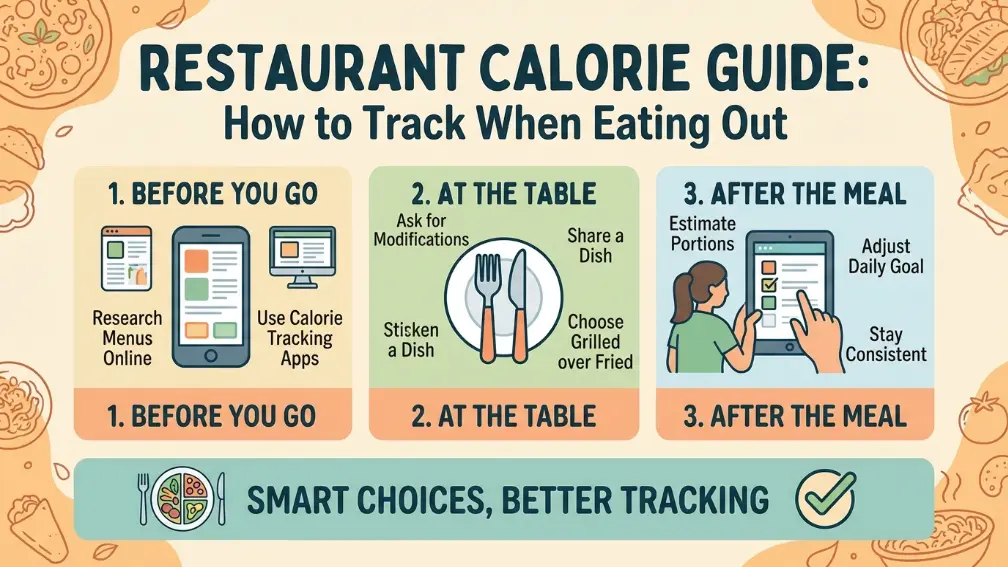
Strategy 4: Order Strategically
Choose menu items that are easier to estimate:
- Simple preparations: Grilled proteins, steamed vegetables
- Ask for modifications: Dressing on side, less oil, no butter
- Avoid mystery dishes: Anything described as "creamy", "rich", or "crispy"
- Check chain restaurant data: Most chains publish nutrition info online
- Use the "plate method": Half vegetables, quarter protein, quarter carbs
Strategy 5: The "Buffer Method" for Untrackable Meals
When you absolutely can't estimate calories:
- Eat half: Restaurant portions are too large anyway
- Log as "generic restaurant meal": Use average estimates (600-800 cal for main)
- Adjust next day: Eat lighter to compensate for uncertainty
- Don't stress: One untracked meal won't ruin your progress
Fast Food vs. Restaurants: What's Different?
| Factor | Fast Food | Restaurants |
|---|---|---|
| Calorie info availability | Usually available | Rarely available |
| Portion consistency | Standardized | Varies widely |
| Ingredient visibility | Simple ingredients | Hidden additions |
| Tracking difficulty | Easy | Hard |
| AI accuracy | 95% | 85% |
Fast food chains like McDonald's, Subway, and Starbucks have detailed nutrition data — check their websites or apps before ordering.
Restaurant Types and Calorie Expectations
Casual Dining (Denny's, IHOP, etc.)
Expect 800-1200 calories for a full meal. Breakfast items are especially calorie-dense.
Tip: Share dishes or take half home.
Fine Dining
Expect 1000-1500 calories for a full meal with appetizer + main + dessert.
Tip: Focus on protein courses, skip bread and dessert.
Italian Restaurants
Pasta dishes: 700-1100 calories. Pizza: 250-350 calories per slice.
Tip: Order pasta with tomato-based sauces, not cream.
Asian Restaurants
Rice-based dishes: 600-900 calories. Noodle dishes: 500-800 calories.
Tip: Request less oil, share dishes, fill up on vegetables.
Mexican Restaurants
Burritos: 800-1200 calories. Tacos: 200-300 calories each.
Tip: Choose soft tacos over crispy, skip cheese and sour cream.
Common Restaurant Calorie Mistakes
- Assuming "salad = healthy": Caesar salad can have 600+ calories with dressing
- Ignoring free items: Bread basket = 150-200 calories per piece
- Not counting drinks: That cocktail is 200-300 calories
- Underestimating sauces: A "drizzle" might be 100+ calories
- Forgetting sides: "Side of fries" = 300-400 calories
- Eating everything: Restaurant portions are designed to be shared
Track Restaurant Meals with AI
CalorieAI makes restaurant tracking effortless. Take a photo before you eat, get instant calorie estimates, and enjoy your meal without stress.
Try CalorieAI free — track restaurant meals in seconds, not minutes.