How many calories should you eat per day?
It's the #1 question everyone asks when starting a weight loss journey. The answer isn't one-size-fits-all — but there's a science-backed formula to find your number.
The Basal Metabolic Rate (BMR) Formula
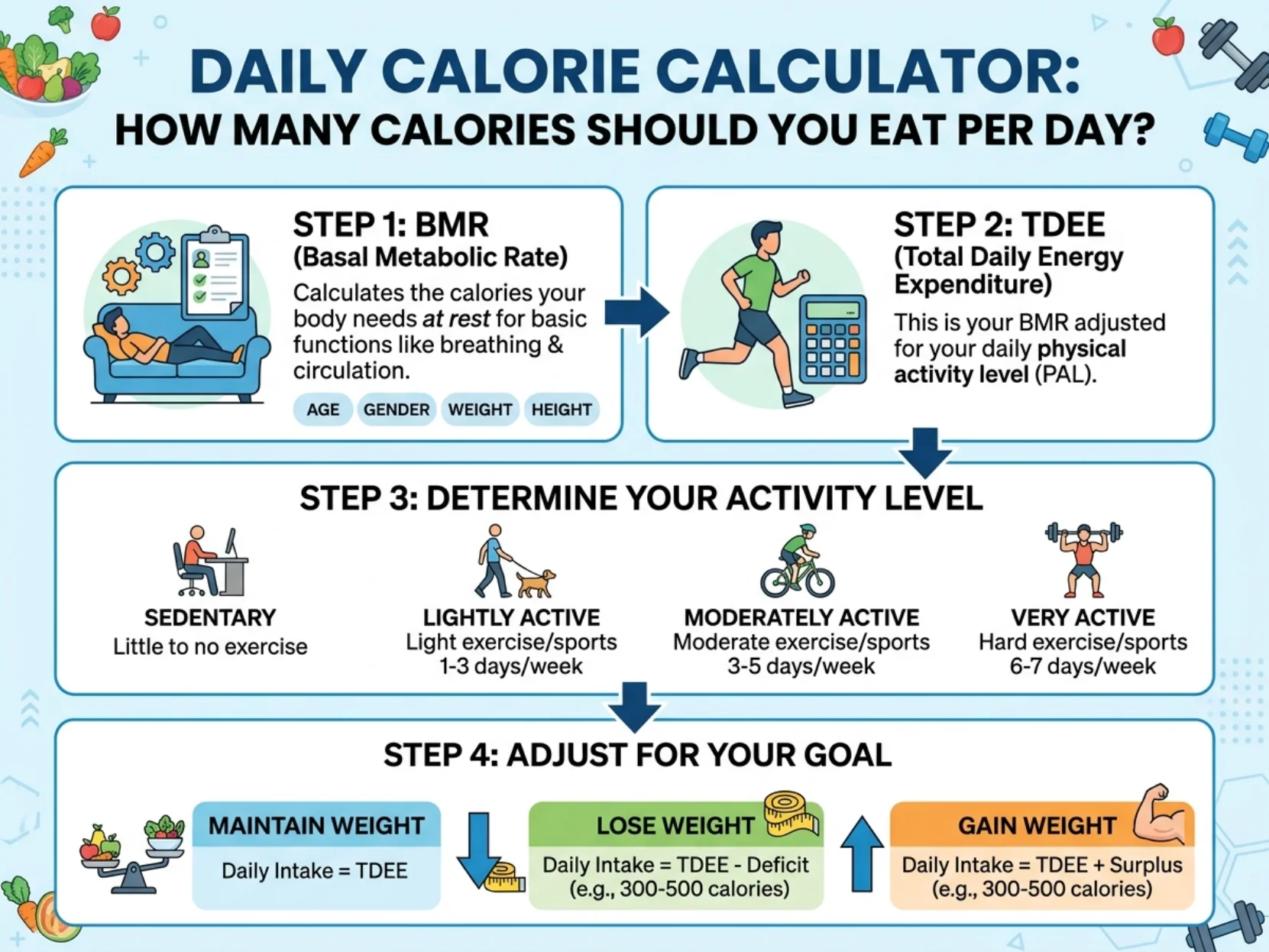
Your body burns calories even at rest. This is called your Basal Metabolic Rate (BMR) — the minimum energy needed to keep your heart beating, lungs breathing, and organs functioning.
Mifflin-St Jeor Equation (Most Accurate)
For men:
BMR = 10 × weight(kg) + 6.25 × height(cm) - 5 × age(years) + 5
For women:
BMR = 10 × weight(kg) + 6.25 × height(cm) - 5 × age(years) - 161
Example Calculation
A 30-year-old woman, 165cm tall, weighing 60kg:
BMR = 10 × 60 + 6.25 × 165 - 5 × 30 - 161 = 1323 calories/day
This means her body burns ~1323 calories just existing — before any movement.
Total Daily Energy Expenditure (TDEE)
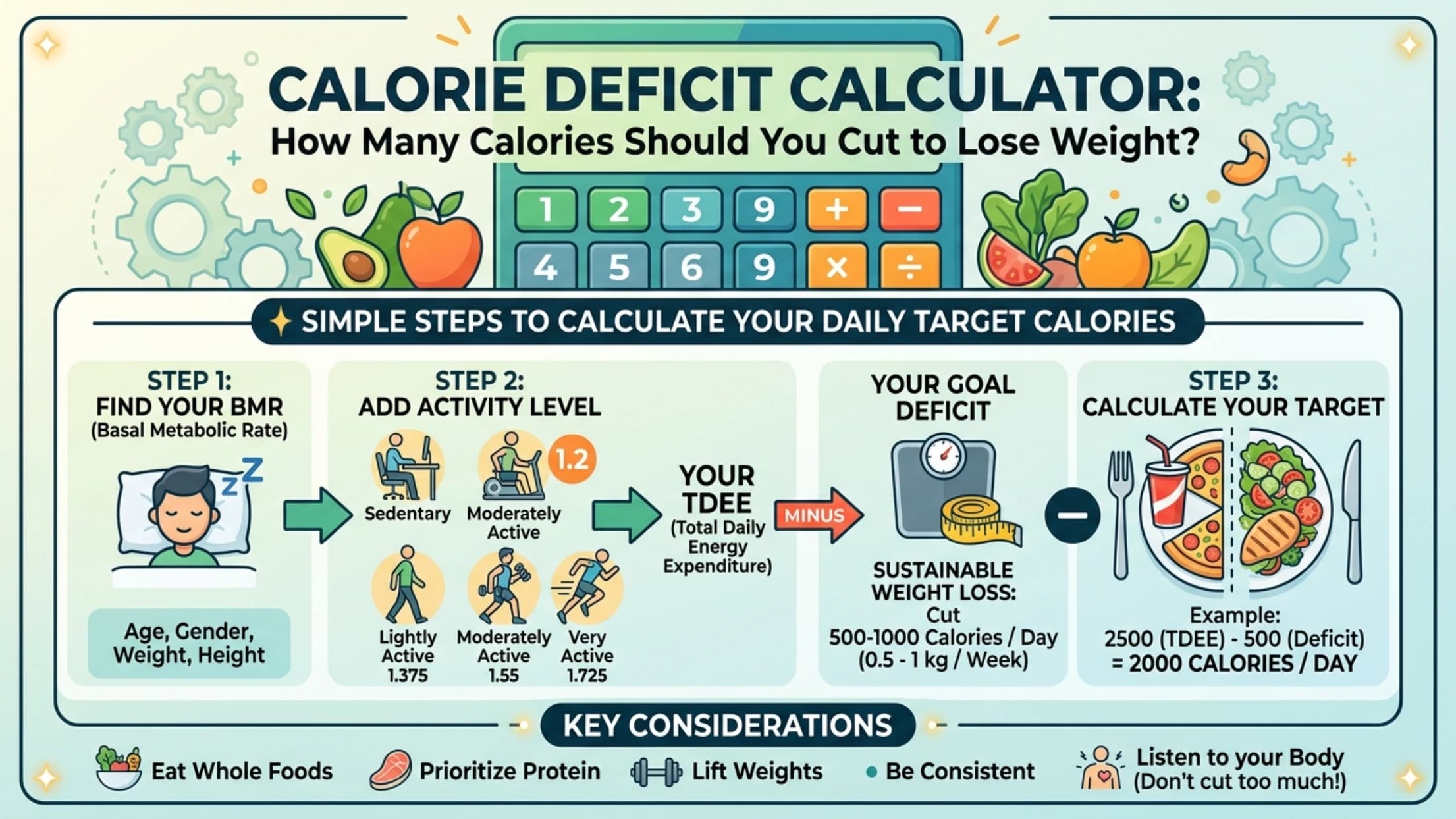
Your actual daily calorie burn depends on activity level. Multiply your BMR by an activity factor:
| Activity Level | Multiplier | Description |
|---|---|---|
| Sedentary | BMR × 1.2 | Little or no exercise, desk job |
| Lightly Active | BMR × 1.375 | Light exercise 1-3 days/week |
| Moderately Active | BMR × 1.55 | Moderate exercise 3-5 days/week |
| Very Active | BMR × 1.725 | Hard exercise 6-7 days/week |
| Extra Active | BMR × 1.9 | Very hard exercise, physical job |
Using our example (BMR = 1323) with moderate activity:
TDEE = 1323 × 1.55 = 2049 calories/day
How Many Calories for Weight Loss?
To lose weight, you need a caloric deficit. But how much?
Safe Deficit Recommendations
- Mild deficit (250 cal/day): Lose 0.25 kg/week — sustainable, lowest risk
- Moderate deficit (500 cal/day): Lose 0.5 kg/week — standard recommendation
- Aggressive deficit (750 cal/day): Lose 0.75 kg/week — for short-term goals
- Maximum safe deficit: Never go below BMR — risk of muscle loss, metabolic damage
Example Weight Loss Target
For our 30-year-old woman (TDEE = 2049):
- Mild deficit: 2049 - 250 = 1799 cal/day
- Moderate deficit: 2049 - 500 = 1549 cal/day
- Aggressive deficit: 2049 - 750 = 1299 cal/day (close to BMR, risky)
Recommended target: 1550-1800 calories/day for sustainable 0.5 kg/week weight loss.
How Many Calories for Weight Gain?
To build muscle or gain weight, you need a caloric surplus:
- Lean gain (+250 cal/day): Gain 0.25 kg/week, mostly muscle with proper training
- Moderate gain (+500 cal/day): Gain 0.5 kg/week, mix of muscle and fat
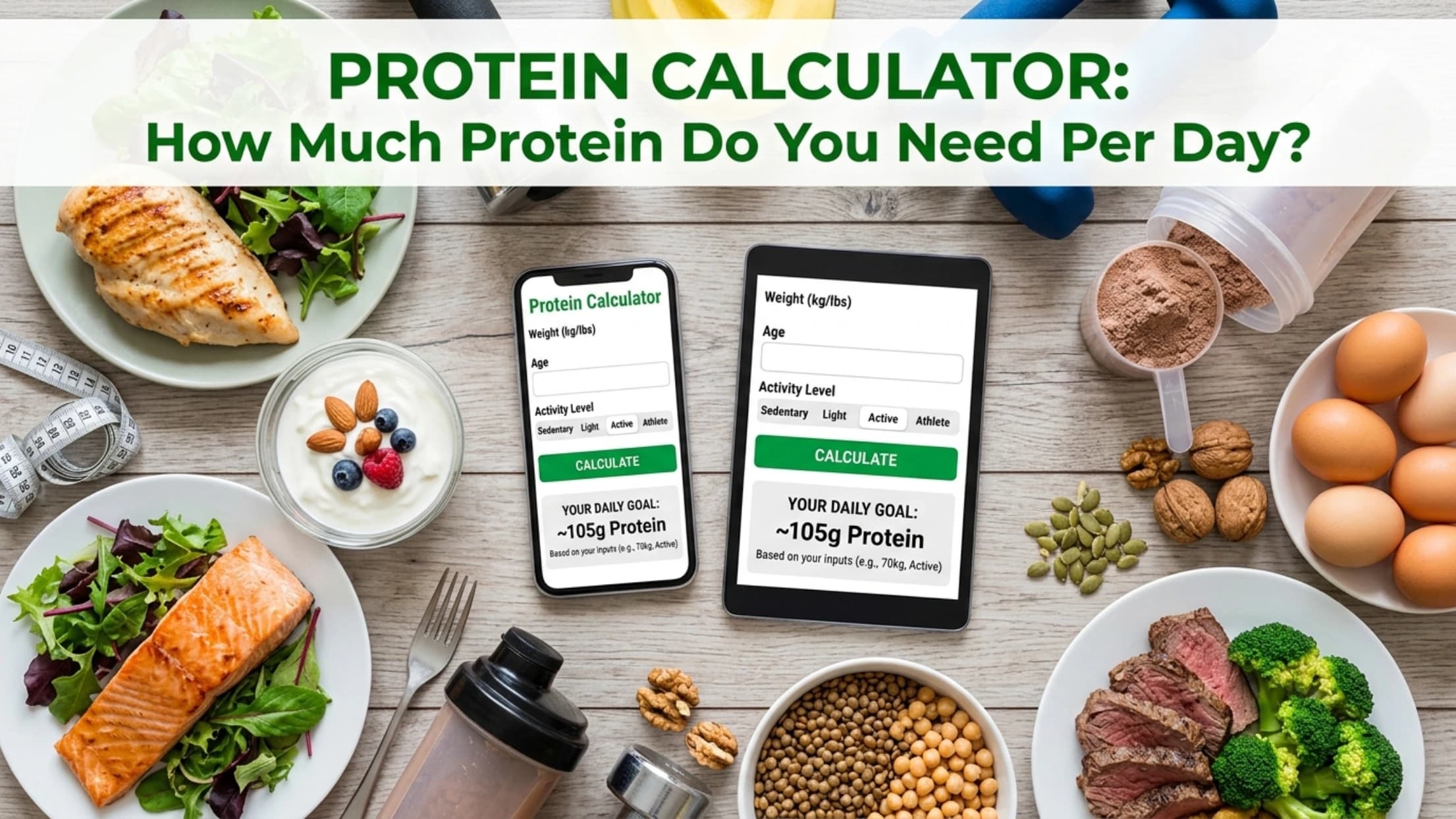
For muscle gain, combine surplus with strength training and adequate protein (1.6-2.2g per kg bodyweight).
The Problem with Calculators: Real Life Isn't a Formula
Online calorie calculators give you a starting number, but reality is messier:
Factors Calculators Miss
- Metabolic adaptation: Your BMR decreases as you lose weight
- Hormonal changes: Stress, sleep, thyroid affect metabolism
- Food quality: 100 cal of broccoli ≠ 100 cal of candy (thermic effect)
- Exercise intensity: A 30-min jog burns differently than a 30-min walk
- Individual variance: Genetic differences of up to 300 cal/day
The solution: Track actual intake and adjust based on results.
How to Find Your True Calorie Target
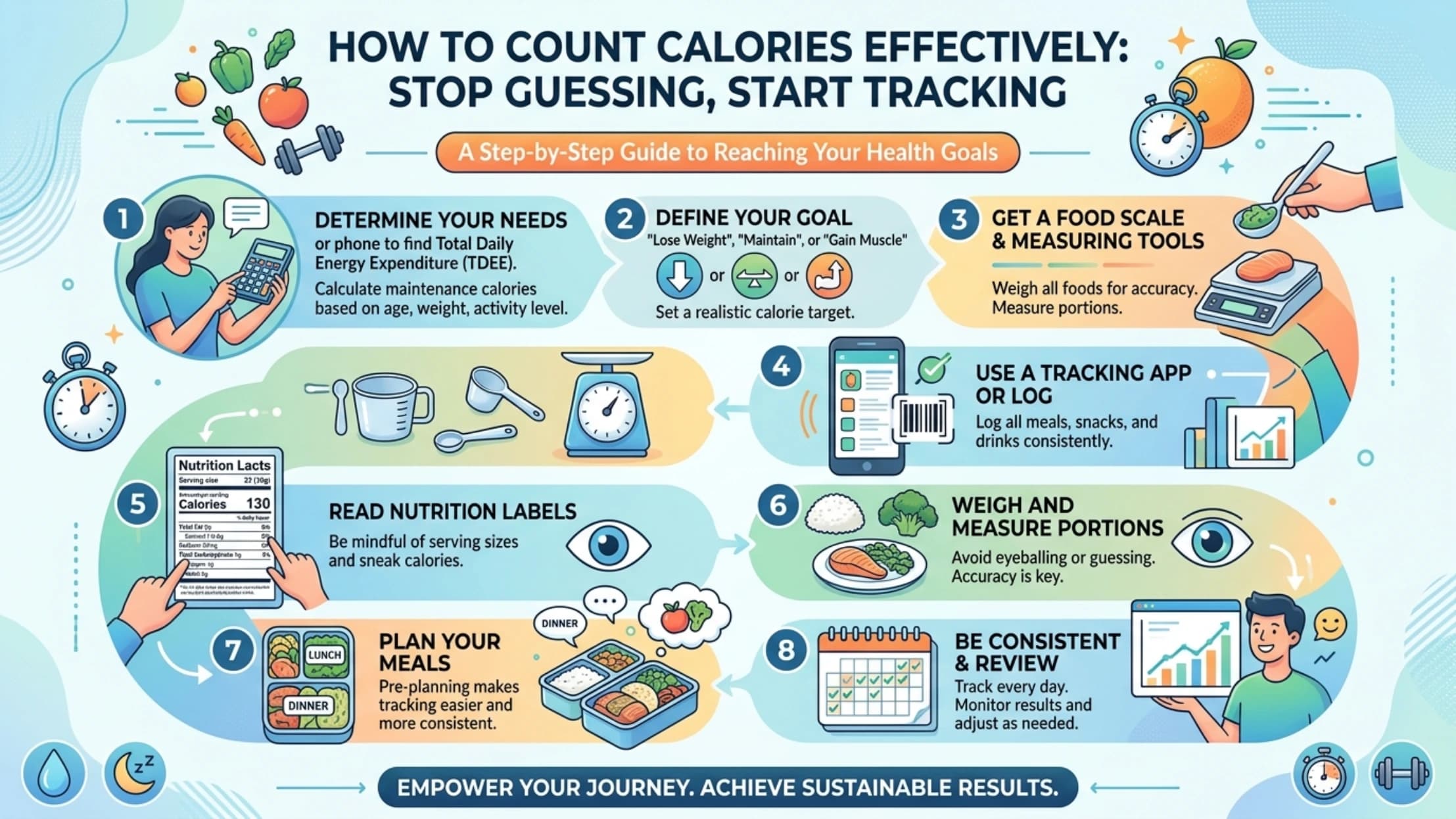
Instead of trusting a calculator, use this 3-step method:
Step 1: Start with a Calculator Estimate
Use the formula above or an online TDEE calculator. This gives you a baseline.
Step 2: Track Your Actual Intake for 2 Weeks
Log every meal accurately. The easiest way: use AI photo recognition.
CalorieAI lets you snap a photo and get instant calorie data — no manual searching, no guessing portions. This eliminates the 40-60% tracking error of manual logging.
Start tracking with CalorieAI Pro for unlimited daily tracking and personalized calorie targets.
Step 3: Adjust Based on Weight Change
After 2 weeks of tracking:
- No weight change: Your intake = your TDEE (maintenance calories found!)
- Lost 0.5 kg: You're in a ~500 cal deficit (good for weight loss)
- Lost more than 1 kg: Deficit too aggressive, increase calories
- Gained weight: Surplus, reduce intake
Quick Reference: Calorie Targets by Goal
| Goal | Daily Calorie Target | Weekly Change |
|---|---|---|
| Maintenance | TDEE | 0 kg |
| Slow Weight Loss | TDEE - 250 | -0.25 kg |
| Standard Weight Loss | TDEE - 500 | -0.5 kg |
| Fast Weight Loss | TDEE - 750 | -0.75 kg |
| Lean Muscle Gain | TDEE + 250 | +0.25 kg |
| Bulking | TDEE + 500 | +0.5 kg |
Common Calorie Target Mistakes
Mistake #1: Going Too Low
Eating below your BMR causes:
- Muscle loss (body breaks down muscle for energy)
- Metabolic slowdown (BMR drops, making weight loss harder)
- Nutrient deficiencies
- Fatigue, brain fog, poor sleep
Rule: Never eat below your BMR for extended periods.
Mistake #2: Not Adjusting Over Time
As you lose weight, your TDEE decreases:
- 10 kg lost = ~100 cal/day lower TDEE
- 20 kg lost = ~200 cal/day lower TDEE
Recalculate your target every 5 kg of weight change.
Mistake #3: Ignoring Protein
Calories matter, but protein protects muscle during weight loss:
- Weight loss: Eat 1.6-2.2g protein per kg bodyweight
- Muscle gain: Eat 1.6-2.2g protein per kg bodyweight
High protein increases thermic effect (burns more calories digesting) and reduces muscle loss.
Start Tracking Your Calories Today
Knowing your calorie target is step one. Tracking accurately is step two.
CalorieAI makes tracking effortless:
- 3-second photo capture: No manual logging, no database searching
- 85%+ accuracy: Better than manual estimates (40-60% error)
- Daily tracking dashboard: See your progress vs. target
- Personalized recommendations: AI adjusts your target based on results
Get CalorieAI Pro — unlimited tracking, personalized targets, and detailed nutrition reports.
Try free today — no credit card required.