Want to lose weight? You need a calorie deficit.
It's the fundamental law of weight loss: burn more calories than you eat. But how big should your deficit be? How do you calculate it? And how do you track it without spending hours logging food?
What Is a Calorie Deficit?
A calorie deficit means consuming fewer calories than your body burns. When you're in a deficit, your body uses stored fat for energy — resulting in weight loss.
The math is simple:
Calorie Deficit = Calories Burned (TDEE) - Calories Consumed
If you burn 2000 calories per day and eat 1500, you're in a 500-calorie deficit.
How Many Calories to Lose Weight?
The size of your deficit determines how fast you lose:
| Daily Deficit | Weekly Weight Loss | Time to Lose 10 kg | Sustainability |
|---|---|---|---|
| 250 calories | 0.25 kg (0.5 lbs) | 40 weeks | ★★★★★ Very sustainable |
| 500 calories | 0.5 kg (1 lb) | 20 weeks | ★★★★☆ Recommended |
| 750 calories | 0.75 kg (1.5 lbs) | 13 weeks | ★★★☆☆ Short-term only |
| 1000 calories | 1 kg (2 lbs) | 10 weeks | ★★☆☆☆ Risky, not advised |
Scientific consensus: A 500-750 calorie deficit is optimal for most people. It's large enough to see results, small enough to maintain long-term.
Calorie Deficit Calculator: Step-by-Step
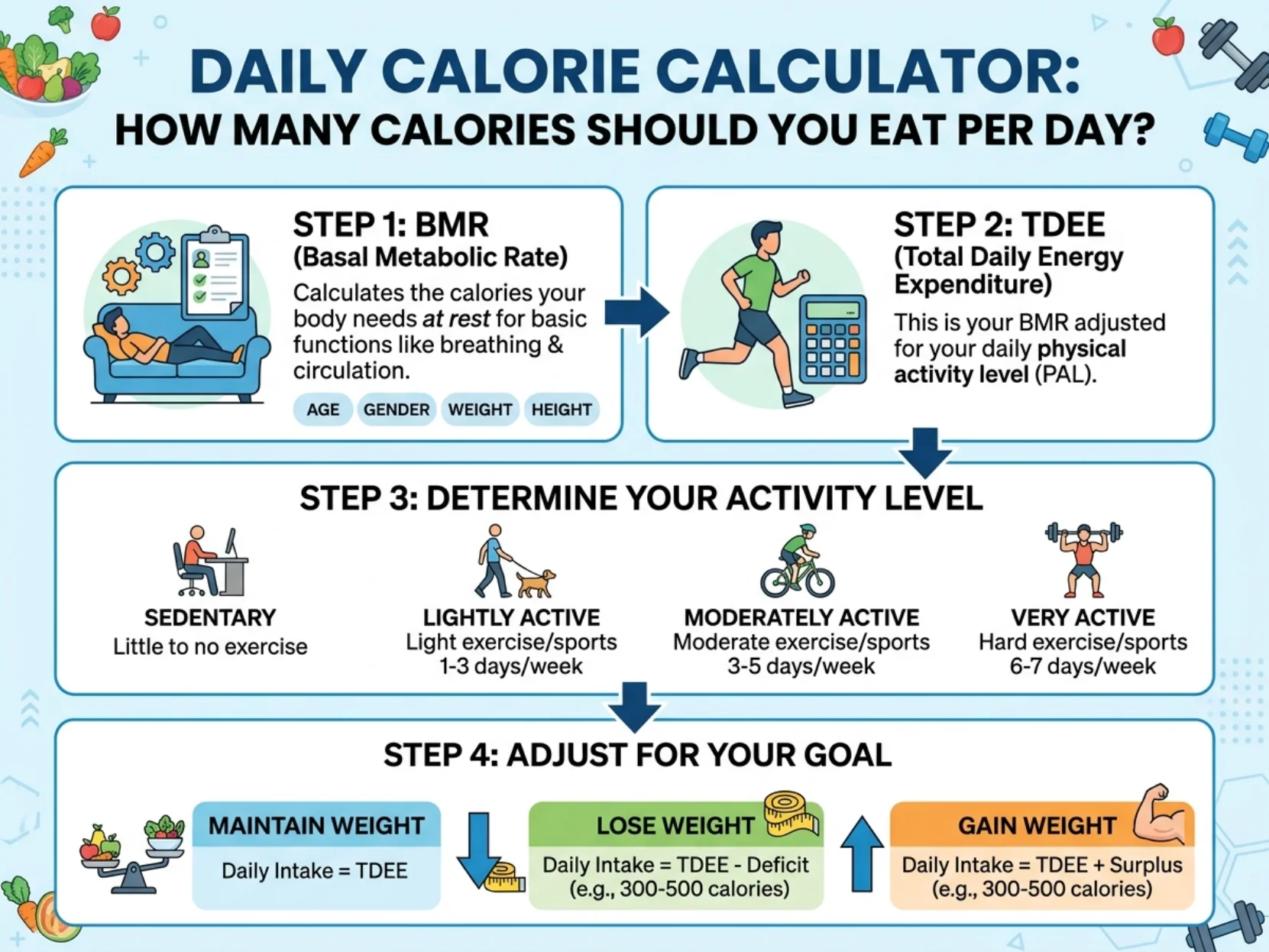
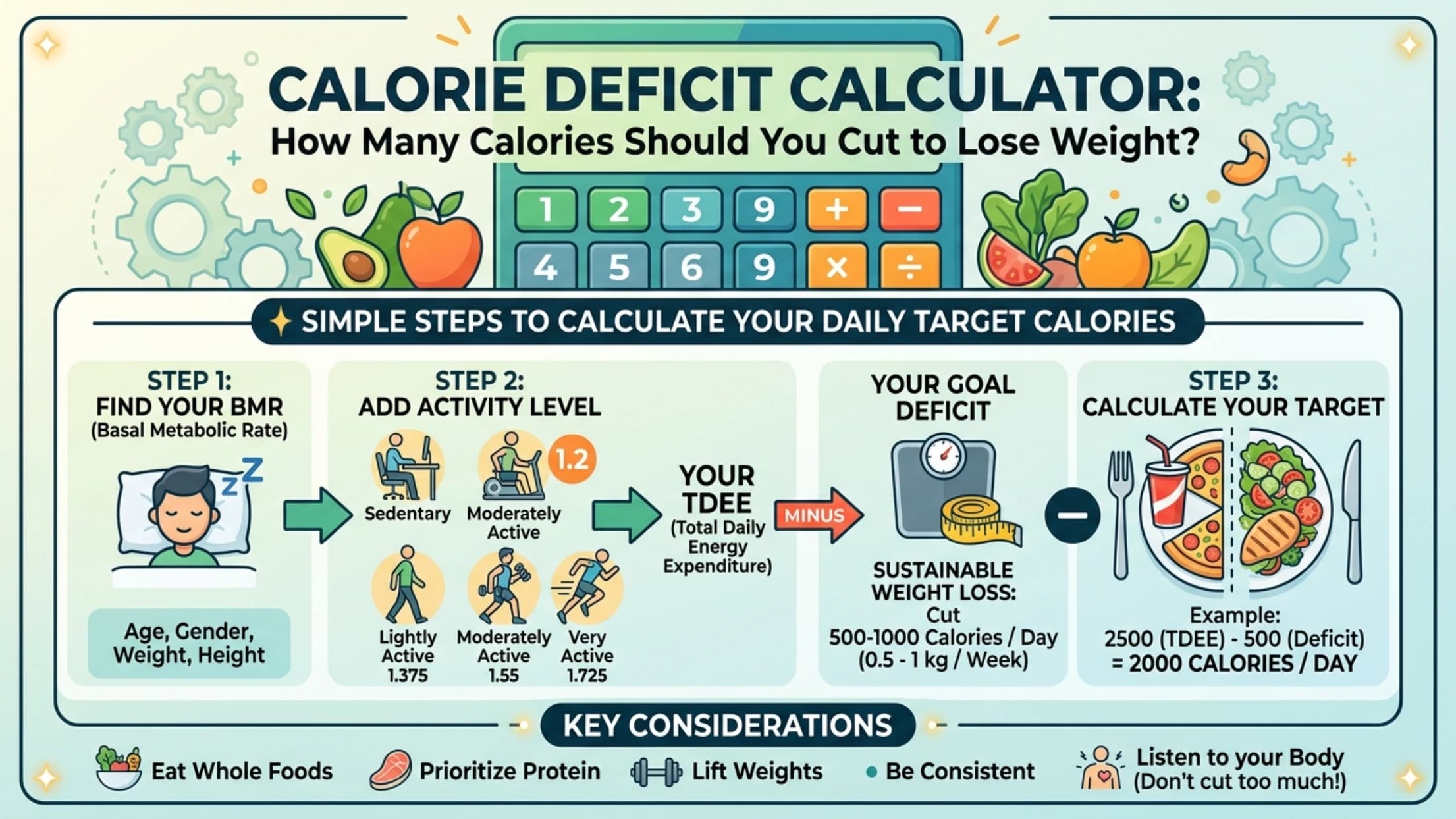
Step 1: Calculate Your TDEE (Total Daily Energy Expenditure)
Your TDEE is the total calories you burn daily. Use the Mifflin-St Jeor equation:
For men:
TDEE = (10 × weight(kg) + 6.25 × height(cm) - 5 × age + 5) × activity multiplier
For women:
TDEE = (10 × weight(kg) + 6.25 × height(cm) - 5 × age - 161) × activity multiplier
Activity multipliers:
- Sedentary (desk job, little exercise): × 1.2
- Lightly active (1-3 workouts/week): × 1.375
- Moderately active (3-5 workouts/week): × 1.55
- Very active (6-7 workouts/week): × 1.725
- Extra active (physical job + training): × 1.9
Step 2: Choose Your Deficit Size
Based on your goals and timeline:
- Slow & sustainable: TDEE - 250 (lose 0.25 kg/week)
- Standard weight loss: TDEE - 500 (lose 0.5 kg/week)
- Faster results: TDEE - 750 (lose 0.75 kg/week)
- Maximum safe: Never below your BMR (Basal Metabolic Rate)
Step 3: Example Calculation
Example: 30-year-old woman, 65 kg, 165 cm, moderately active
Step 1 - BMR:
10 × 65 + 6.25 × 165 - 5 × 30 - 161 = 650 + 1031 - 150 - 161 = 1370 calories
Step 2 - TDEE:
1370 × 1.55 = 2118 calories/day
Step 3 - Weight loss target:
2118 - 500 = 1618 calories/day
Her calorie target: 1600-1650 calories per day for steady 0.5 kg/week weight loss.
Calorie Deficit Calculator Quick Reference
| Your TDEE | Mild Deficit (250) | Standard (500) | Faster (750) |
|---|---|---|---|
| 1500 cal | 1250 cal | 1000 cal (too low) | 750 cal (unsafe) |
| 1800 cal | 1550 cal | 1300 cal | 1050 cal (risky) |
| 2000 cal | 1750 cal | 1500 cal | 1250 cal |
| 2200 cal | 1950 cal | 1700 cal | 1450 cal |
| 2500 cal | 2250 cal | 2000 cal | 1750 cal |
| 2800 cal | 2550 cal | 2300 cal | 2050 cal |
Warning: Never eat below 1200 calories (women) or 1500 calories (men) without medical supervision. Below these thresholds, you risk nutrient deficiencies, muscle loss, and metabolic damage.
Why Most Calorie Deficits Fail
Reason 1: Calculating TDEE Wrong
Most people overestimate their activity level. "I walk to work" ≠ moderately active. True moderate activity means 45-60 minutes of intentional exercise 3-5 times per week.
Solution: Use the lower activity multiplier if unsure. Sedentary or lightly active is safer for most office workers.
Reason 2: Not Tracking Accurately
Studies show people underestimate calorie intake by 40-60%. Common errors:
- Portion sizes: "Medium" is subjective — could be 200 or 400 calories
- Hidden calories: Cooking oil (120 cal/tbsp), salad dressing (100+ cal), sauces
- Forgotten items: That morning latte (150 cal), handful of nuts (200 cal)
- Restaurant meals: Generic database entries are 30-50% off
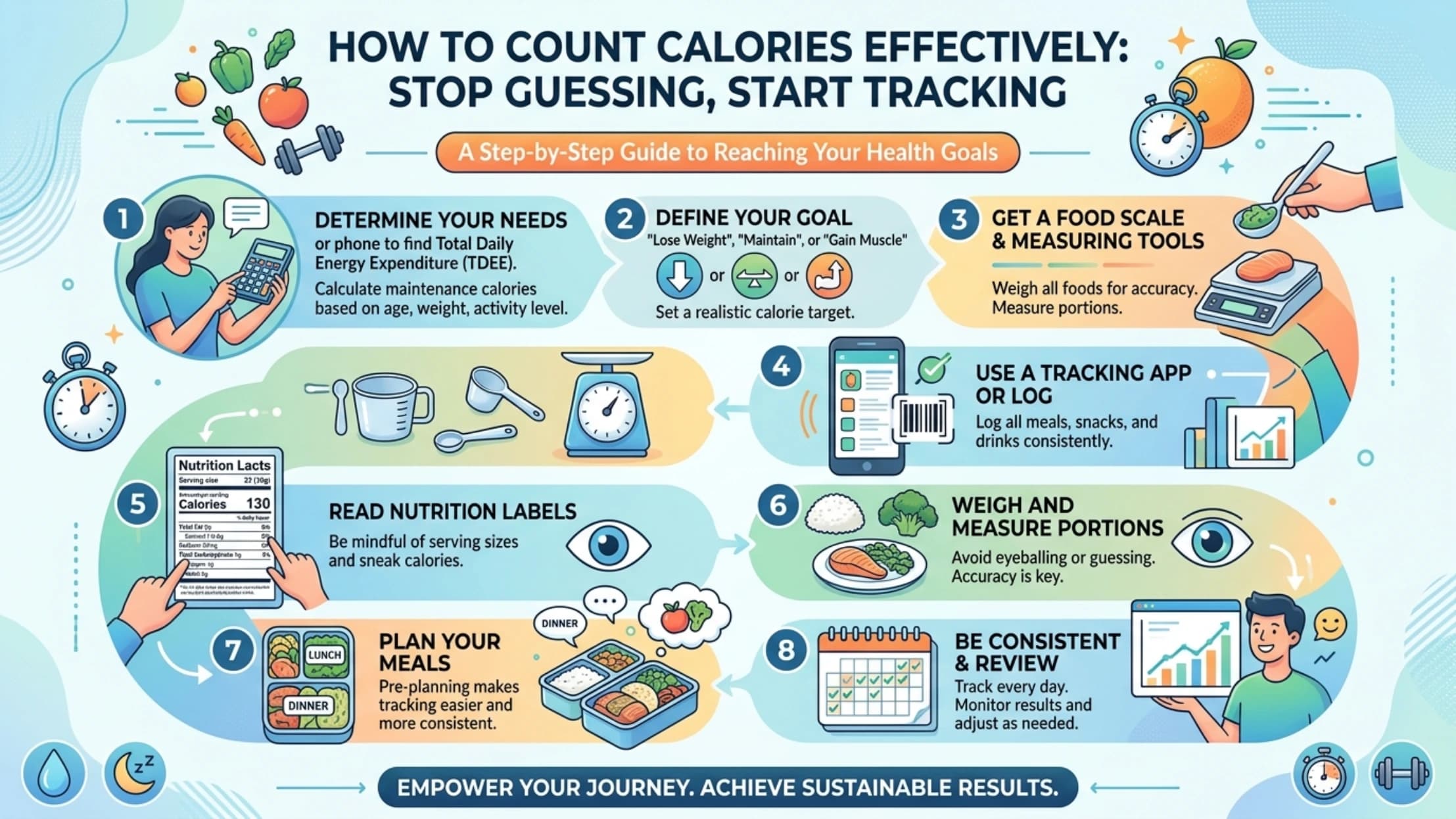
Solution: Use AI photo tracking. CalorieAI analyzes your actual food visually, eliminating guesswork. Accuracy improves from 40-60% error to 10-15%.
Reason 3: Deficit Too Large
Aggressive deficits (1000+ calories) cause:
- Muscle loss: Body breaks down muscle for energy, not just fat
- Metabolic slowdown: BMR drops 15-30%, making future weight loss harder
- Hunger & cravings: Extreme deficits trigger binge eating
- Nutrient deficiencies: Hard to get enough protein, vitamins on 1200 cal
Solution: Stick to 500-750 calorie deficit. Add exercise to increase TDEE rather than cutting food further.
Reason 4: Not Adjusting Over Time
As you lose weight, your TDEE decreases:
- 5 kg lost → TDEE drops ~50 cal/day
- 10 kg lost → TDEE drops ~100 cal/day
- 20 kg lost → TDEE drops ~200 cal/day
If you don't adjust your target, your deficit shrinks and weight loss stalls.
Solution: Recalculate your TDEE every 5 kg of weight change.
How to Create Your Deficit Without Starving
Option A: Eat Less (Calorie Reduction)
The simplest approach: reduce intake by your deficit amount.
- Cut 500 cal/day: Remove one large snack, reduce portions, skip dessert
- Easiest targets: Drinks (soda, juice, alcohol), snacks, second portions
- Keep protein high: 1.6-2.2g per kg to preserve muscle
Option B: Move More (Increase TDEE)
Burn more without eating less:
- Add 500 cal exercise: 45-60 min jogging, 60-90 min brisk walking, 30 min HIIT
- NEAT (Non-Exercise Activity): Take stairs, park farther, stand more
- Strength training: Builds muscle, increases resting metabolism
Option C: Combine Both (Best Results)
Research shows combining diet + exercise works best:
- Reduce intake by 300 cal: Smaller portions, fewer snacks
- Add 200 cal exercise: 30 min daily walk
- Total deficit: 500 cal/day with less hunger
Track Your Deficit with AI
Creating a deficit requires tracking. But manual tracking fails because:
- It takes 10-15 minutes per meal
- Portion guesses are 40-60% wrong
- Restaurant meals have no accurate database entries
CalorieAI solves this with photo recognition:
- 3-second capture: Snap a photo before eating
- 85%+ accuracy: Visual analysis beats manual guessing
- Asian food specialist: Recognizes dishes other apps can't
- Daily dashboard: See your deficit vs. target instantly
Try CalorieAI free — no credit card required.
Get Pro for unlimited tracking and personalized deficit recommendations.