You're tracking calories, but the scale isn't moving.
It's frustrating. You log every meal, stay under your calorie goal, but week after week — no weight loss. The problem? You're probably making calorie counting mistakes you don't even know about.
The Hidden Truth: Why Calorie Tracking Often Fails
Research reveals a shocking statistic: the average person underestimates their calorie intake by 40-60%. Even people who track diligently make errors that add up to hundreds of calories per day.
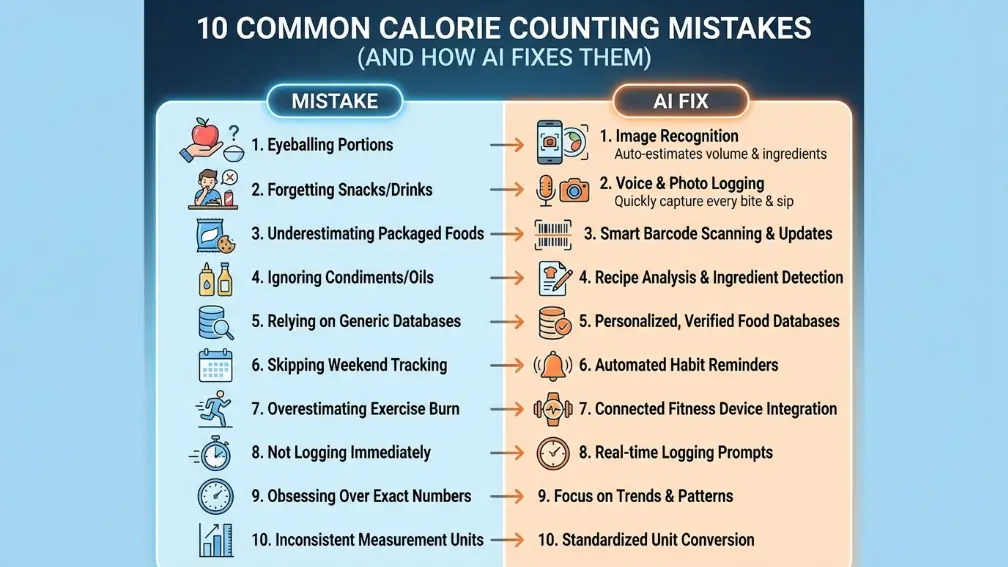
Here are the 10 most common calorie counting mistakes — and how to fix them.
Mistake #1: Forgetting "Hidden Calories"
The biggest source of tracking errors isn't your main meals — it's what you add to them.
Common Hidden Calories
| Item | Typical Calories | Why It's Forgotten |
|---|---|---|
| Cooking oil (1 tbsp) | 120 | Poured from bottle, not measured |
| Salad dressing | 150-200 | "Light" dressing still has calories |
| Mayo/Aioli | 100 | Spread on bread, invisible |
| Butter on toast | 100 | "Just a little" = a lot |
| Coffee creamer | 50-100 | Daily habit, not logged |
| Sauce on dishes | 100-200 | Restaurant additions |
| Oil in stir-fry | 150-200 | Cooks add more than you think |
Impact: 300-500 hidden calories per day = no weight loss despite "perfect" tracking.
How AI Fixes This
CalorieAI's photo recognition detects visible oils, sauces, and dressings automatically. It also applies "restaurant multipliers" to account for hidden cooking fats.
Mistake #2: Portion Size Guessing
When you don't measure portions, you're 30-50% off on average.
Common Portion Errors
- Protein: You think it's 150g, but it's actually 250g (+200 calories)
- Rice/Pasta: You log 100g, but the plate has 200g (+150 calories)
- Nuts: "A handful" is 50g, not 30g (+100 calories)
- Cheese: "Sprinkle" = 30g, not 10g (+80 calories)
Impact: 200-400 calories per meal from portion guessing.
How AI Fixes This
AI photo recognition uses visual volume analysis to estimate portions more accurately than eyeballing. For best results, photograph the entire plate clearly.
Mistake #3: Not Logging Snacks
The "I just had a bite" mentality destroys tracking accuracy.
Sneaky Snack Calories
- 3 crackers: 60 calories
- Handful of chips: 150 calories
- Piece of cheese: 100 calories
- 2 cookies: 150 calories
- "Taste test" while cooking: 50-100 calories
Impact: 200-400 calories per day from unlogged "bites" and "tastes".
The Fix
Log everything immediately. Use CalorieAI to snap photos of snacks before eating — this creates a habit of tracking even small items.
Mistake #4: Trusting Package Labels Too Much
Nutrition labels are allowed to be 20% off from actual values.
Label Issues
- Serving sizes are unrealistic: "1/2 cookie" isn't how people eat
- Calories per serving are rounded down: 49 calories becomes "45"
- Hidden ingredients: "Natural flavors" might include sugar
- Restaurant portions differ: Package serving ≠ actual portion
Example: A package says 150 calories per serving, but you eat 1.5 servings. That's 225 calories, not the 150 you logged.
The Fix
Track actual portions, not label servings. AI photo recognition can estimate the actual amount you're eating, not the "suggested serving size."
Mistake #5: Ignoring Drinks
Liquid calories are the most overlooked category.
Common Drink Calories
| Drink | Calories | How It's Forgotten |
|---|---|---|
| Latte (16oz) | 190 | "It's just coffee" |
| Smoothie | 300-500 | "It's healthy" |
| Beer (1 pint) | 200 | Social drinking, not logged |
| Cocktail | 250-300 | Mixed drinks have hidden sugar |
| Juice (12oz) | 180 | "Natural" still has sugar |
| Sports drink | 150 | Workout context, ignored |
Impact: 200-500 calories per day from drinks alone.
The Fix
Log every drink. Use CalorieAI for coffee drinks and cocktails — the AI recognizes drink types and estimates calorie content from visual analysis.
Mistake #6: Using Generic Database Entries
When you search for "homemade lasagna" and pick a random database entry, you're guessing.
Why Generic Entries Fail
- Recipes vary: Your mom's lasagna ≠ the database lasagna
- Regional differences: Chinese dishes have 20+ variations
- Restaurant vs. home: Same dish, different calories
- Old data: Database entries might be 10+ years outdated
Example: Database "kung pao chicken" might be 400 calories, but the restaurant version is 600+ due to extra oil.
How AI Fixes This
CalorieAI's AI analyzes your actual dish from the photo, not a generic database entry. It applies visual context: identifying cooking method, sauce thickness, and portion size.
Mistake #7: Logging Late (or Never)
The longer you wait to log, the more you forget.
Timing Errors
- Logging at end of day: Forgotten snacks, underestimated portions
- Logging next day: Memory errors compound
- "I'll log it later": Later becomes never
Impact: Late logging adds 100-300 calories of forgotten items per day.
The Fix
Log immediately before eating. This creates a habit loop and ensures accurate portion capture. AI photo apps like CalorieAI make instant logging possible — 8 seconds per meal.
Mistake #8: Over-Exercising Calories
Fitness trackers overestimate calorie burn by 20-50%.
Common Exercise Overestimates
- Treadmill says 300 burned: Actually ~200
- Apple Watch says 500: Actually ~350
- "I worked hard": Perceived exertion ≠ calorie burn
The trap: "I burned 500 calories exercising, so I can eat 500 more." But you only burned 350, and you eat 500. Net gain: 150 calories.
The Fix
Use conservative estimates. For exercise calories, count 50-70% of what your tracker says. Or ignore exercise calories entirely and stick to your base target.
Mistake #9: Ignoring Weekends
Weekends are where diets die.
Weekend Tracking Patterns
- Saturday "cheat day": 2000+ untracked calories
- Social meals: Alcohol, appetizers, desserts not logged
- "I'll start Monday": Sunday becomes untracked too
Impact: One weekend can undo 5 days of perfect tracking. 1500 daily deficit × 5 days = 7500 deficit. Then 2500 weekend surplus = net 5000 deficit, not 7500.
The Fix
Track weekends too. Use CalorieAI to snap photos at social events — it's fast and discreet. Don't aim for perfection, just consistency.
Mistake #10: Giving Up After One Bad Day
The most dangerous mistake isn't a tracking error — it's the psychological response.
The "All or Nothing" Trap
- One untracked meal: "I ruined it, might as well quit"
- One overeating day: "Tracking doesn't work anyway"
- One week without progress: "This is hopeless"
Reality: One bad day doesn't erase weeks of progress. Weight loss is about average intake over time, not individual days.
The Fix
Track imperfectly rather than not at all. A rough estimate (600 calories for that restaurant meal) is better than skipping it entirely. Consistency beats perfection.
How AI Solves These Mistakes Automatically
CalorieAI addresses the top 5 tracking errors without any extra effort from you:
| Mistake | Manual Tracking Error | AI Fix |
|---|---|---|
| Hidden calories | 400 cal/day | Detects visible sauces/oils |
| Portion guessing | 300 cal/day | Visual volume estimation |
| Database mismatch | 200 cal/day | Analyzes your actual dish |
| Late logging | 200 cal/day | 3-second photo capture |
| Restaurant meals | 300 cal/day | 85% accuracy vs. 40% manual |
Total saved: ~1400 calories per day of tracking errors eliminated.
Stop Making Mistakes, Start Seeing Results
Calorie tracking works when done accurately. CalorieAI makes accuracy automatic — just snap a photo and get real data, not guesses.
Try CalorieAI free — eliminate tracking mistakes without extra effort.