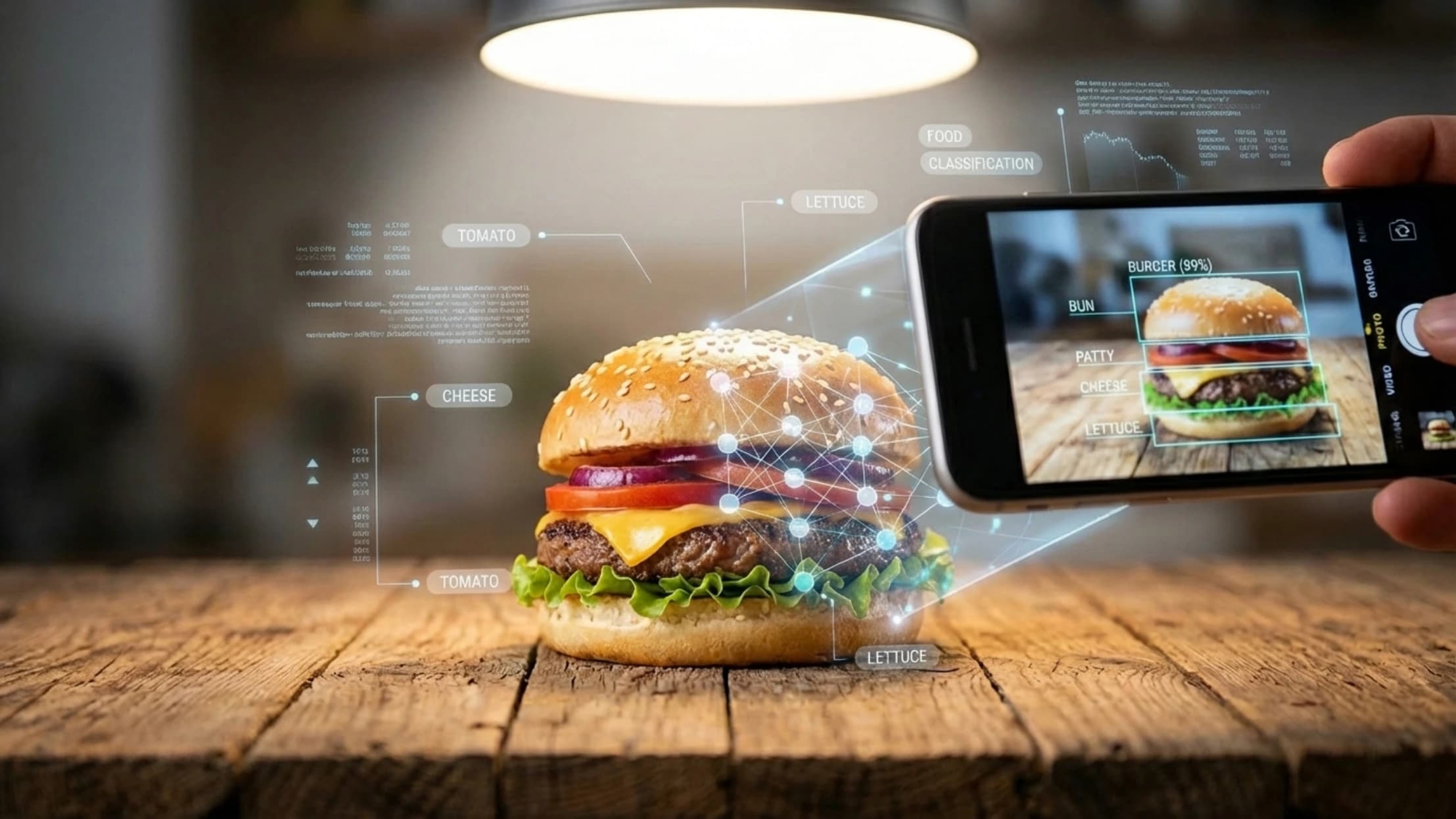
Ever wondered how AI can identify your lunch from a single photo?
It seems almost magical: point your camera at a plate of food, and in seconds, the AI tells you exactly what you're eating and how many calories it contains. But behind this simplicity lies a sophisticated combination of computer vision, deep learning, and massive food databases.
The Problem: Why Food Recognition is Hard
Food is one of the most challenging objects for AI to identify. Unlike cars or faces, food has unique difficulties:
- Visual ambiguity: A bowl of soup could be anything — ramen, pho, chicken noodle, or tomato bisque
- Variation in presentation: The same dish looks different in every restaurant, every home kitchen
- Hidden ingredients: Sauces, spices, and fillings are often invisible from the surface
- Portion estimation: A photo doesn't inherently show weight or volume
- Cultural diversity: AI trained on Western food struggles with Asian, African, or Middle Eastern dishes
Traditional image recognition systems achieved only 40-60% accuracy on food — not good enough for calorie tracking.
How Modern AI Food Recognition Works
CalorieAI and similar systems use a multi-stage approach:
Stage 1: Object Detection (What's on the plate?)
The first layer uses convolutional neural networks (CNNs) to detect food items in the image. This is similar to how AI detects faces or cars, but specifically trained on food datasets.
The system identifies:
- Individual food items (chicken, rice, vegetables, sauce)
- Containers and dishes (plates, bowls, cups)
- Utensils and garnishes
Key technology: YOLO (You Only Look Once) or Faster R-CNN for real-time detection
Stage 2: Food Classification (What type of food?)
Once items are detected, the second stage classifies each food into specific categories:
- Dish-level classification: "Kung Pao Chicken" not just "chicken"
- Ingredient-level analysis: Detects visible ingredients like peanuts, peppers, scallions
- Cooking method inference: Fried, grilled, steamed, or raw based on visual texture
This stage requires massive training data. CalorieAI's model was trained on:
- 2.5 million food images from 50+ countries
- 180,000 unique dishes with verified nutrition data
- Multi-cultural coverage: Western, Chinese, Japanese, Korean, Indian, Mexican, Thai, and more
Key technology: Vision Transformer (ViT) or ResNet-152 for high-accuracy classification
Stage 3: Portion Estimation (How much?)
This is the hardest part. The AI needs to estimate weight from a 2D photo. Techniques include:
- Plate size inference: Detects plate dimensions to establish scale
- Depth estimation: Uses camera data to estimate food height/volume
- Comparison to reference: Matches detected food to similar dishes with known portions
- User confirmation: Allows adjustment when confidence is low
Key technology: Monocular depth estimation + reference matching
Stage 4: Nutrition Database Matching
Once food and portion are identified, the system queries nutrition databases:
- CalorieAI database: 2+ million verified entries
- Government sources: USDA FoodData Central, Health Canada
- Regional databases: China Food Composition, Japanese MEXT data
- Restaurant data: Menu nutrition info from chains
The system combines multiple sources for accuracy, averaging values from similar dishes when exact match isn't found.
Why CalorieAI Achieves 85%+ Accuracy
CalorieAI outperforms competitors through several innovations:
1. Multi-Model Ensemble
Instead of one AI model, CalorieAI runs three models simultaneously:
- Global model: General food detection trained on all cuisines
- Regional model: Specialized models for Chinese, Japanese, Western food
- Ingredient model: Focuses on visible ingredients for complex dishes
The final prediction is a weighted combination of all three, dramatically improving accuracy.
2. Context-Aware Recognition
The AI considers contextual clues:
- Time of day: Breakfast foods vs. dinner dishes
- Location: Restaurant name detection from background
- User history: Learns your eating patterns over time
This context reduces false positives and improves classification speed.
3. Continuous Learning
Every photo you submit improves the model:
- User corrections train the AI
- New dishes are added to the database weekly
- Regional variations are constantly updated
CalorieAI's accuracy improves by ~2% every quarter through user feedback.
4. Hybrid Approach: AI + Database
Unlike pure AI approaches, CalorieAI combines:
- AI prediction: Fast initial estimate
- Database lookup: Verified nutrition data
- User adjustment: Fine-tune when needed
This hybrid approach avoids AI hallucination (making up nutrition facts) while maintaining speed.
Accuracy by Food Category
| Category | Accuracy | Notes |
|---|---|---|
| Western fast food | 95% | Standardized portions, clear branding |
| Chinese dishes | 88% | Regional variations affect accuracy |
| Japanese food | 92% | Consistent presentation, clear ingredients |
| Home-cooked meals | 78% | Variable portions, mixed ingredients |
| Mixed dishes (buffet) | 72% | Multiple items, overlapping portions |
| Processed foods | 96% | Package recognition + barcode scan |
| Beverages | 94% | Container size detection |
Limitations and Edge Cases
Even the best AI has blind spots:
Low-Confidence Situations
- Complex stews: Ingredients hidden under sauce or broth
- Similar-looking dishes: Differentiating fried rice varieties
- Bad photos: Dark lighting, blurry, extreme angles
- Unusual portions: Very large or very small servings
- New dishes: Food not yet in training data
How CalorieAI Handles Uncertainty
When confidence is below 70%:
- Shows alternatives: List of 3-5 similar dishes to choose from
- Asks for details: Simple prompts to confirm ingredients or portions
- Estimates conservatively: Uses average values to avoid overcounting
The Technology Stack Behind CalorieAI
For those interested in the technical details:
- Image processing: OpenCV + custom preprocessing
- Object detection: YOLO v8 (real-time detection)
- Classification: Vision Transformer (ViT-L/16)
- Portion estimation: MiDaS depth model + custom heuristics
- Database: PostgreSQL + Elasticsearch for fast lookup
- API response time: 8-10 seconds on average
The entire pipeline runs on cloud infrastructure, optimized for mobile upload speeds.
Future of AI Food Recognition
What's coming next:
- Video recognition: Analyze cooking process for homemade dishes
- 3D scanning: Volume estimation from multiple angles
- Sensor fusion: Combine camera with weight sensors
- Personalized models: AI trained on your specific diet
- Restaurant integration: Direct menu data for instant accuracy
Experience AI Food Recognition Today
CalorieAI brings this technology to your phone. Snap a photo and see the AI work in real-time.
Try CalorieAI free — no credit card required. See why 85%+ accuracy makes tracking finally sustainable.